The Brass Family

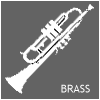
The brass family is known for its piercing and strong sound. Players have to use their own lips to do the vibrating that is needed to produce the desired sounds. Brass instruments use piston valves to produce its range of notes. The main instruments of the brass family are the Trumpet, Trombone, French Horn and Tuba. (Blackwood 1993, Itashiki 2006, Jesse et al. 1998)


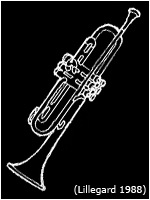
Trumpet

  • The trumpet is renowned for its ceremonial sound, often dubbed as instruments of pageantry.
  • Adds strength and brilliance to the orchestra at moments of climax.
  • It has three valves.
  • Length: 56cm

(Blackwood 1993, Itashiki 2006, Jesse et al. 1998)

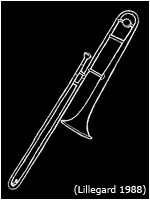
Trombone

  • The trombone has a slide valve mechanism rather than piston valves to produce different pitches.
  • It is used for 'glissando' effects (sliding up and down the scale).
  • There are seven different positions in using the slide valve.
  • Length: 200cm

(Blackwood 1993, Itashiki 2006, Jesse et al. 1998)

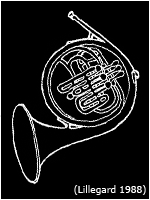
French Horn

  • The french horn is a complicated instrument, with three valves, a large bell and a mouthpiece.
  • The player puts his fist into the bell to change the tone of the note produced.
  • It produces a clear mellow sound.
  • Length: 55cm

(Blackwood 1993, Itashiki 2006, Jesse et al. 1998)

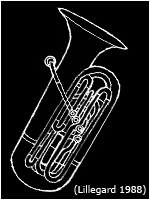
Tuba

  • The tuba comes in 5 different sizes.
  • It is the deepest-pitched brass instrument in the family.
  • It has three piston valves.
  • It is held upright in the player's lap when played.

(Blackwood 1993, Itashiki 2006, Jesse et al. 1998)