The Strings Family

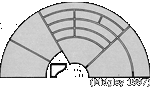
Four of the most well-known string instruments in the orchestra are the Violin, Viola, Cello and Double Bass. However, they are also the ones which are often mistaken for one another due to their similar shape and method of playing. They make up the largest number of instruments in the orchestra (Blackwood 1993). Two other string instruments that have significant roles in the orchestra are the Harp and the Piano.

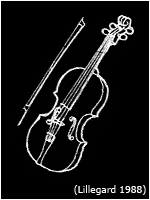
Violin

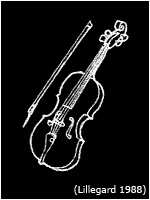
  • The violin has four strings: G, D, A and E.
  • It sounds its own note when stroked by the bow or plucked.
  • Different pitches are produced when the string is pressed at various positions.
  • It is held under the chin, resting on the shoulder.
  • It has tuning pegs to alter the pitch of the string.
  • Length: 58cm

(Blackwood 1993, Itashiki 2006, Jesse et al. 1998)

Viola

  • The viola has four strings: C, G, D and A.
  • It sounds its own note when stroked by the bow or plucked.
  • Different pitches are produced when the string is pressed at various positions.
  • It is held under the chin, resting on the shoulder.
  • It has tuning pegs to alter the pitch of the string.
  • It is slightly larger than the violin, with a deeper range of pitched notes.
  • Usually used as a supporting harmonic line below violins.
  • Length: 74cm

(Blackwood 1993, Itashiki 2006, Jesse et al. 1998)

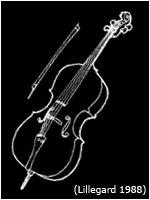
Cello

  • The cello has four strings: C, G, D and A.
  • It sounds its own note when stroked by the bow or plucked.
  • Different pitches are produced when the string is pressed at various positions.
  • It is much larger than the violin, hence it must be played sitting down and held between the knees.
  • It has tuning pegs to alter the pitch of the string.
  • Produces a strong, rich and deep tone.
  • Length: 1.22m

(Blackwood 1993, Itashiki 2006, Jesse et al. 1998)

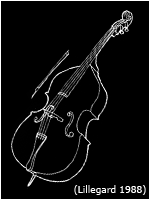
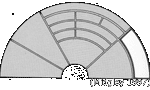
Double Bass

  • The double bass has four strings: D, G, C and F.
  • Similar playing method to violin, viola and cello.
  • The player has to either sit on a high stool or stand to play it.
  • Important rhythm instrument in jazz and popular music
  • Produces a deep, gruff sound.
  • Adds depth and weight to the whole body of string sound.
  • Length: 1.8m

(Blackwood 1993, Itashiki 2006, Jesse et al. 1998)

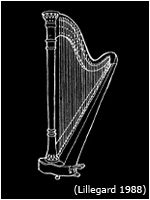
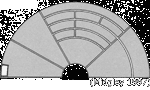
Harp

  • The harp has 46 strings, each of different length and tension.
  • It has seven pedals to change the length of each string to produce different notes.
  • The harpist plays with both hands.
  • Often used to play 'arpeggios', or runs of notes.
  • Length: 1.8m

(Blackwood 1993, Itashiki 2006, Jesse et al. 1998)

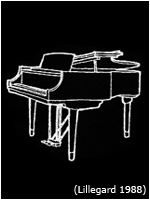
Piano

  • The piano produces its sound by using hammers to strike its strings and bounce off again.
  • It has the ability to play a large dynamic range (softness and loudness).
  • The pianist plays with both hands, pressing the keys on the keyboard.
  • Length: 2.7m

(Blackwood 1993, Itashiki 2006, Jesse et al. 1998)